How to Write More: 10 Steps for Building a Daily Writing Habit

Introduction
People who develop micro-habits are 2x more likely to sustain long-term progress compared to those who rely on willpower alone. In other words, you don’t need to be a “born writer.” You need systems, discipline, and strategies.
Writing more isn’t about waiting for inspiration—it’s about building a daily writing habit.
In this guide, we’ll break down the 10 most effective steps for writing more daily, with practical examples, proven research, and actionable takeaways.
Why Building a Daily Writing Habit Matters
Before diving into the steps, let’s clarify why a daily writing practice is so powerful:
-
Consistency beats talent: Writing for 30 minutes every day is more impactful than waiting for a “perfect” day of inspiration.
-
Improves clarity & creativity: Daily writing helps organize thoughts and improves idea generation.
-
Boosts productivity: Writers who commit to regular schedules produce 3x more content on average (Content Marketing Institute, 2024).
-
Builds discipline: Writing daily trains your brain to focus, even when motivation is low.
Now, let’s dive into the 10 proven steps to write more and develop a daily writing habit.
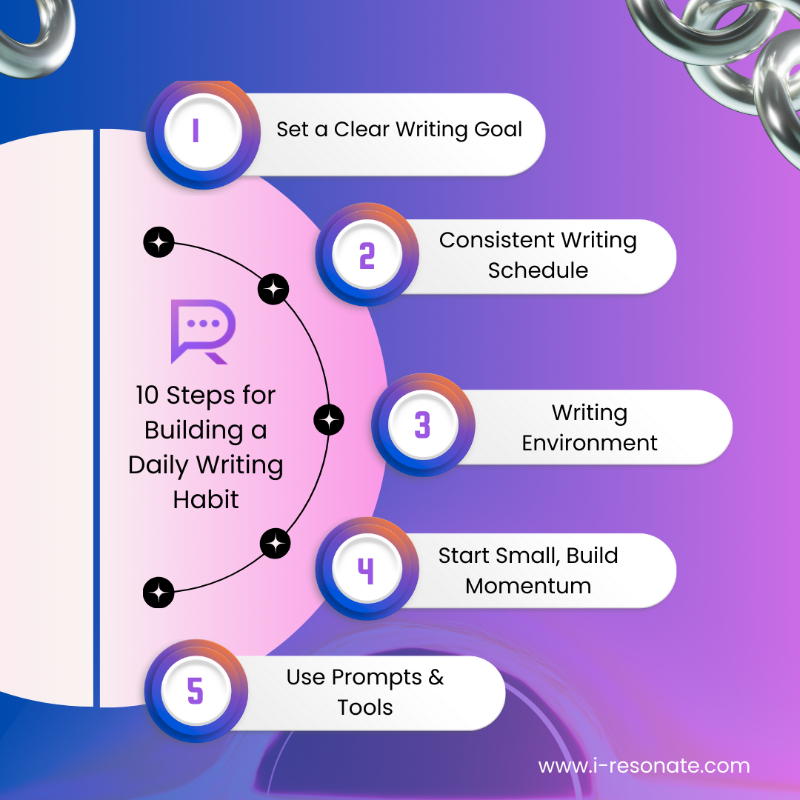
Step 1: Set a Clear Writing Goal
Without a clear target, it’s difficult to measure progress or stay motivated.
Writers who set SMART goals (Specific, Measurable, Achievable, Relevant, Time-bound) are more likely to improve steadily.
Example: “Write 500 words a day for 30 days.” This is specific, measurable, and realistic.
Variation: If word count feels overwhelming, focus on time: “Write for 25 minutes daily.” Studies suggest that short, consistent writing sessions are more sustainable than irregular marathons.
Step 2: Create a Consistent Writing Schedule
Consistency beats intensity. An average of 66 days to form a new habit. Writing at the same time daily signals your brain to shift into “creative mode.”
-
Morning writers like Hal Elrod (author of The Miracle Morning) use early hours for creative focus.
-
Night writers like Haruki Murakami prefer evenings when distractions are minimal.
Example: Schedule writing from 7:30–8:00 AM before work or class.
Variation: If mornings don’t work, tie writing to an existing habit (e.g., “after lunch” or “before bedtime”).
Step 3: Design Your Writing Environment
Your surroundings have a direct impact on your ability to focus. Eliminating just one distraction can improve productivity by up to 31%.
Good Setup: A clutter-free desk, noise-canceling headphones, and focus tools like MINDWRITE to block digital distractions.
Bad Setup: Multitasking with 10 tabs open, notifications buzzing, and your phone within reach — a recipe for fragmented attention.
Step 4: Start Small, Build Momentum
The biggest mistake new writers make? Trying to crank out 2,000 words on Day 1.
Writing habits don’t grow from burnout — they grow from small, consistent wins.
Start Simple: Begin with just 10 minutes a day. Once it feels natural, gradually increase to 30 minutes or set realistic word-count goals.
In Atomic Habits, James Clear emphasizes the “2-minute rule” — start with the smallest version of the habit, like writing a single sentence daily. The key is consistency. Once you show up regularly, momentum takes care of the rest.
Step 5: Use Prompts & Tools to Kickstart Writing
Blank pages intimidate even pros. Writing prompts can reduce “writer’s block” by 40%.
-
Daily prompts: Journaling questions like “What’s one lesson I learned today?”
-
Platforms like MindWrite and i-Resonate’s ContentCraft take it further — generating prompts, drafting outlines, or even refining your brand voice in seconds
-
Example: A student struggling with essay writing could start with a prompt like “Why is climate change the biggest challenge of our generation?” and expand gradually.
-
Step 6: Silence Your Inner Editor
Perfectionism is one of the biggest barriers to writing productivity. Writers who often lose momentum by over-editing early drafts, which kills flow and delays progress.
Do This Instead:
-
Draft Freely: Write without stopping to polish.
-
Edit Later: Separate your writing and editing sessions so your brain can focus on one task at a time.
Author Anne Lamott famously calls this the “shitty first draft” approach — your only job in the first round is to get words on paper. Refinement comes afterward.
Step 7: Track Your Progress
Progress tracking is one of the most powerful motivators. A study by the University of Chicago found that visible progress boosts motivation by 45%, reinforcing discipline and momentum.
-
Tools: Google Docs word count, Notion habit trackers, or apps.
-
Visual cue: Mark daily progress on a physical calendar (Jerry Seinfeld’s “don’t break the chain” method).
Example: If you’re writing a book, seeing that you’ve hit your 500-word target for 15 consecutive days is motivating enough to keep going.
Pro Tip: MindWrite automatically tracks your daily exercises and performance trends, turning invisible progress into visible motivation.
Step 8: Reward Yourself for Consistency
Consistency forms habits, but rewards make them stick. Neuroscience research shows that rewards trigger dopamine release, reinforcing positive behavior.
In a 2023 Medium writing challenge, participants who tied small rewards to milestones reported a 33% higher completion rate compared to those who didn’t.
Step 9: Find Accountability Partners
Writing doesn’t have to be a solo journey. Accountability dramatically boosts results — studies show people are 65% more likely to meet goals when they share them with someone else.
-
Writing groups: Join online communities (Reddit’s r/writing or Twitter #WritingCommunity).
-
Partner system: Pair with a friend and send daily word counts.
-
Professional support: Use coaching or group challenges (like NaNoWriMo).
Step 10: Reflect and Iterate
.Not every routine will work for you. Reflection helps optimize your approach.
-
Ask yourself:
-
Which time of day feels easiest for me to write?
-
What distractions keep breaking my flow?
-
Am I hitting word count but sacrificing quality?
Example: Netflix often iterates its promotional writing strategy by analyzing engagement. If short-form teasers perform better than long posts, they adapt immediately. Writers can use the same principle.

Watch full you tube video of Mindwrite here:
Practical Example: A 30-Day Writing Habit Plan
Here’s how you could apply the 10 steps in real life:
-
Week 1: Write for 10 minutes daily, track progress.
-
Week 2: Increase to 20 minutes, add prompts.
-
Week 3: Target 500 words daily, share progress online.
-
Week 4: Reflect, tweak timing, and celebrate with a reward.
By Day 30, you’ll have a consistent daily writing habit—and potentially 10,000–15,000 words written.
Tools to Help Build a Daily Writing Habit
-
MindWrite: Free AI-powered writing tool that offers prompts, argument development practice, and structure help.
-
Grammarly: For grammar and tone checks.
-
Notion / Evernote: To track progress and organize drafts.
-
Pomodoro Timer: To manage time with 25-minute focused sessions.
Conclusion
Learning how to write more daily isn’t about sudden inspiration—it’s about creating systems that make writing non-negotiable. From setting clear goals and schedules to using tools like MindWrite and ContentCraft, these 10 steps help transform writing into a sustainable habit.
Don’t chase perfection. Chase consistency. Your words will multiply, your confidence will grow, and writing will become second nature.
FAQs
1. How long does it take to build a daily writing habit?
Iit takes about 66 days on average to form a lasting habit. However, with micro-goals (like writing 10 minutes daily), you can see consistent progress within 30 days.
2. How many words should I write every day?
It depends on your goals. Beginners can start with 300–500 words daily, while advanced writers might aim for 1,000+ words. The key is consistency—not hitting massive word counts on Day 1.
3. What’s the best time of day to write?
There’s no universal “best time.” Many writers prefer mornings for fresh focus, while others write best at night when distractions are low. Track your energy patterns and pick the time you feel sharpest.
4. How do I overcome writer’s block?
Use prompts, free-writing, or AI-powered tools like MindWrite to generate ideas. Remember, writer’s block often comes from fear of imperfection—so focus on progress, not polish, in your first draft.
5. Should I write every single day?
Yes—at least at the beginning. Daily repetition helps lock in the habit. But it doesn’t always have to be long-form content; journaling or note-taking counts too.
6. How can AI tools help with writing habits?
AI assistants like MindWrite or ContentCraft can:
-
Suggest prompts when you’re stuck.
-
Maintain brand voice consistency.


anchal
I'm Anchal Mogha, an SEO Expert and Digital Marketer with a strong background in business development . With an MBA in Marketing and Business Analytics, I blend data-driven strategies with creative storytelling to help Brands grow Online.